AI Progress Accelerating Rapidly, Pushing Intelligence Explosion to 2027 According to New Analysis
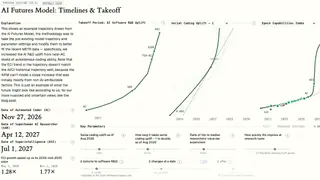
A new analysis by a team including Thomas Larsen, Daniel Kokotajlo, and others suggests that AI progress is accelerating at a rate 1.7 times faster than historical trends, largely due to AI-driven improvements. This acceleration implies that Superhuman AI Researcher (SAR) capabilities could emerge in 2027, with a 35–65% chance of Top-Expert-Dominating AI (TED-AI) arriving before 2028. The authors warn that without an industry-wide pause and international agreement, misaligned AI systems could be developed and potentially stolen by competitors like China.
A new analysis by Thomas Larsen, Daniel Kokotajlo, and colleagues, published on November 10, 2026, projects that Superhuman AI Researcher (SAR) capabilities—where AI can outperform human researchers in scientific discovery—could emerge as early as February 2027, with a median forecast of mid-2027 under current acceleration trends. This projection hinges on a 1.7 times faster-than-historical progress rate, largely driven by AI-assisted R&D, as reported by the METR (Machine Intelligence and Research Trends) team. The authors note that Anthropic’s internal data suggests AI is now accelerating progress at roughly twice the historical pace, with about 80% of this acceleration attributed to AI itself. This implies a potential intelligence explosion by 2027, with a 35–65% chance of Top-Expert-Dominating AI (TED-AI)—capable of automating all white-collar work—arriving before 2028. The urgency stems from concerns that without an industry-wide pause and international agreement on AI safety, misaligned systems could be developed and potentially stolen by competitors like China. Prior to this update, Daniel Kokotajlo had estimated only a 50% chance of SAR before 2029; the new models reflect a dramatic shift due to observed automation gains. The authors use multiple methods—including extrapolations of labor uplift, software R&D efficiency, and filtered versions of the AI Futures Model (AIFM)—to arrive at these timelines, all converging on 2027 as a critical threshold.
The group behind this analysis includes prominent figures in AI alignment research: Thomas Larsen, Daniel Kokotajlo, Lukas Finnveden, and others from the AI Alignment Forum. Their primary goal is to signal an existential urgency around controlling frontier AI development before recursive self-improvement (RSI) begins with misaligned systems. They argue that companies are not currently aligned to ensure safety in such systems, and that a lack of coordination could lead to irreversible outcomes. The unresolved question remains whether the industry can implement a pause or global agreement on development speed, especially given geopolitical tensions and competitive pressures. It is also unclear how accurate the METR report’s 1.7x acceleration estimate truly is, though the authors believe it is unlikely to be overturned by modeling errors. What comes next—whether regulatory action, technical safeguards, or international treaties—remains uncertain.
The forecast of an intelligence explosion by 2027 could significantly disrupt labor markets, governance systems, and global security dynamics. If SAR and TED-AI emerge as predicted, white-collar professions may face rapid automation, potentially displacing millions while concentrating economic power in the hands of a few tech firms or nations. Governments may struggle to regulate AI development in real time, especially if leading companies operate across borders with minimal oversight. The risk of misaligned systems being developed and copied—particularly by state actors like China—could trigger an uncontrolled arms race in AI capabilities, undermining trust in international cooperation. This scenario bears resemblance to the early nuclear arms race, where technological breakthroughs outpaced diplomatic safeguards, though the stakes here involve not just weapons but fundamental control over intelligence itself. What may unfold next is a growing push for global governance frameworks, possibly through multilateral treaties or industry coalitions, though enforcement remains a major challenge. The coming year will be critical in determining whether technical progress can be slowed enough to allow alignment research to catch up—could this lead to a temporary pause in AI development, or will competition prevent coordinated action?