Scientists Map Male Fruit Fly Brain, Sparking Internet-Driven AI Experiments
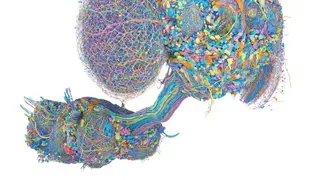
Researchers have created the first detailed connectome of a male fruit fly's brain, mapping over 166,000 neurons and their connections. The publicly shared dataset quickly attracted internet users who trained AI models on it to perform tasks like playing Doom and simulating bitcoin trades. While not an actual brain upload, the project highlights how neuroscientific data can inspire novel computational applications and public engagement with complex science.
In September 2026, researchers at the Howard Hughes Medical Institute’s Janelia Research Campus unveiled the first detailed connectome of a male fruit fly’s brain, mapping over 166,000 neurons and their synaptic connections across the entire nervous system. This dataset, publicly released as part of a two-decade-long effort to understand neural circuitry, represents a significant milestone in neuroscience, particularly because it is the first comprehensive map from a male specimen—allowing for future comparisons with female fly brains. The project was led by Gerald M. Rubin and his team, whose work builds on prior connectome studies in fruit flies but expands the scope with unprecedented detail. The data quickly went viral online, attracting not just neuroscientists but internet users who began training artificial intelligence models on it. These AI experiments included teaching virtual fly brains to play Doom, simulate bitcoin trades, and solve puzzles like the Rubik’s Cube—demonstrating how biological neural architecture can inspire novel computational behaviors. While researchers emphasize this is not a brain upload or consciousness transfer, the phenomenon highlights a growing trend of public engagement with complex scientific data through AI “vibe coding.” Experts like Bing Wen Brunton of the University of Washington note that these models adapt by modifying connection parameters during training, mimicking neural plasticity but without replicating actual cognition. The broader implications remain unresolved: while no biological fly is playing video games, the event underscores how accessible neuroscientific data may fuel both innovation and public imagination in unexpected ways.
The viral use of a fruit fly connectome to train AI for gaming and trading tasks reflects a broader societal shift where scientific datasets are repurposed by non-experts through accessible AI tools. This phenomenon could deepen public understanding of neuroscience while blurring lines between biological intelligence and machine learning, potentially raising ethical questions about digital personhood or the limits of metaphor in science communication. The event mirrors earlier internet phenomena like the “DeepDream” meme explosion, where neural network outputs were widely shared for their surreal aesthetic, though here the engagement is more functional—users are applying real data to solve problems. Such trends may influence how research institutions release data, possibly encouraging open-access models that prioritize public interaction over traditional peer review. Institutions like Scientific American and companies such as Latitude may see increased interest in AI-driven science outreach, potentially reshaping science journalism and education. However, it remains unclear whether this enthusiasm will translate into sustained scientific literacy or dissipate as novelty fades. What’s emerging is a new form of participatory science—where the public doesn’t just consume findings but actively experiments with them—suggesting that future research may be co-created in digital communities.