Anthropologists Play Key Role in Ethical Site Selection for Major Physics Projects
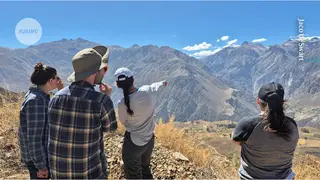
A new initiative to build a cosmic particle observatory in the Peruvian Andes is including social scientists as core team members, recognizing that ethical and cultural considerations are vital in scientific planning. The TAMBO project’s interdisciplinary approach ensures that local communities' perspectives and heritage are respected during site selection. This collaboration highlights how science increasingly depends on humanities expertise for responsible innovation.
In November 2026, the Tau Air-shower Mountain-based Observatory (TAMBO) project, a proposed cosmic particle observatory in the Peruvian Andes, is advancing with an unprecedented inclusion of social scientists as core team members. Unlike traditional scientific planning, where site selection focuses solely on geological and atmospheric conditions, TAMBO’s approach integrates anthropologists and historians from the outset. This shift marks a significant departure: for the first time, one-quarter of project meeting attendees are social-science scholars, reflecting a formal recognition that ethical and cultural dimensions are essential to responsible science. The initiative is led by Jaco de Swart, a historian and anthropologist of science at the University of Cambridge, UK, who emphasizes that site selection must account for local communities’ heritage and perspectives. The project aims to detect tau neutrinos—rare cosmic particles—by deploying detectors in high-altitude Andean terrain, but its success hinges not only on technical feasibility but also on community consent and cultural sensitivity. This model builds on earlier critiques of large-scale scientific projects that proceeded without adequate consultation, such as the construction of observatories in Hawaii’s Mauna Kea, where Indigenous protests highlighted the need for inclusive planning.
The TAMBO project could signal a broader transformation in how major scientific infrastructure is conceived and approved. By embedding anthropologists and historians into core decision-making, it may set a precedent for future large-scale projects—such as deep-sea mining operations or space-based telescopes—where cultural and environmental impacts are not secondary concerns but foundational to legitimacy. This approach may influence funding bodies and international science councils to require social impact assessments before approving projects, potentially reshaping research ethics frameworks. A comparable earlier case is the controversy over the Thirty Meter Telescope on Mauna Kea, where scientific ambitions clashed with Indigenous spiritual claims, leading to prolonged legal battles and delays. TAMBO’s proactive inclusion of local voices may prevent similar conflicts, fostering trust and long-term cooperation. However, it remains unclear how this model will scale across different geopolitical and cultural contexts. The project may also raise questions about power dynamics: who defines “community consent,” and how are marginalized voices amplified? If successful, TAMBO could inspire new interdisciplinary standards in science policy—though its real-world impact will depend on whether such inclusion leads to tangible changes in project design or merely symbolic participation.