Analyzing AI Takeoff Speeds and Recursive Self-Improvement in Safety Discourse
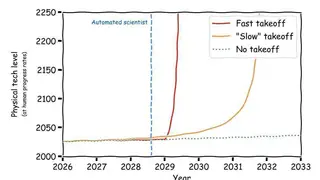
This document compiles insights on the debate between fast and slow AI takeoff scenarios, contrasting Paul Christiano's historical precedent-based argument for gradual progress with Eliezer Yudkowsky's view of abrupt transformation. It examines how societal inertia—regulatory delays and adoption lags—may influence deployment timelines. The notes are intended for use in AI safety education and aim to clarify key concepts around recursive self-improvement (RSI) and exponential growth trajectories.
In November 2026, Chris_Leong published informal notes on AI takeoff speeds and recursive self-improvement (RSI) for use in AI safety education, drawing from prior writings by Paul Christiano (2018), Eliezer Yudkowsky (2021), and others. Christiano’s model posits a slow takeoff, defined as a sequence where world output doubles over increasingly shorter intervals—e.g., 4 years, then 2 years—based on historical patterns of technological progress, where incremental improvements precede breakthroughs. In contrast, Yudkowsky envisions a fast takeoff, where growth remains near-stagnant (5% annually) until an abrupt transformation occurs within seconds, possibly leading to irreversible outcomes like the “paperclip maximizer” scenario. These views are grounded in differing assumptions about societal inertia: Yudkowsky emphasizes adoption and regulatory lag as critical bottlenecks, while Christiano sees gradual integration as inevitable. The notes also reference Tom Davidson’s response to Yudkowsky’s X post and Arvind Narayanan’s argument that RSI would likely be narrow or jagged—accelerating on measurable tasks but stalling on broader, unverifiable ones. Richard Ngo similarly anticipates a divergence between observable capability gains and real-world impact, suggesting the future may appear “much weirder than almost anyone expects.” The material distinguishes takeoff speed from timelines, noting that fast takeoff could occur even with long timelines, and identifies three types of intelligence explosion: software-only RSI, AI-driven improvements in hardware and software, and full-stack automation involving chip production.
The debate over AI takeoff speed shapes how institutions assess risk and allocate resources. If a fast takeoff is likely, then delays in policy or safety research could be catastrophic, making early intervention critical—potentially justifying urgent regulatory action even at high economic cost. Conversely, if takeoff is slow, gradual governance and industry adaptation may suffice, reducing pressure for immediate intervention. This tension influences funding priorities in AI safety research, with organizations like Forethought and the Alignment Forum emphasizing scenario modeling to inform strategy. The broader impact may be a bifurcation in policy: some governments could push for rapid oversight frameworks based on fast takeoff models, while others adopt a wait-and-see stance. Comparable to early nuclear weapons development, where uncertainty about yield and deployment timelines drove both arms races and non-proliferation efforts, the AI safety debate may lead to parallel tracks of innovation and regulation. What remains unclear is whether empirical evidence from current AI systems—such as the observed jaggedness in capability gains—will converge toward one model or remain ambiguous. The next step likely involves more granular testing of RSI feasibility across different domains, which could shift consensus on whether exponential growth is sustainable or inherently constrained by physical and institutional limits.