PsiQuantum Develops Low-Loss Optical Switch to Boost AI Data Center Performance
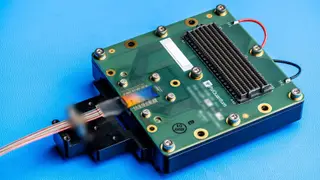
PsiQuantum has created a silicon photonics-based optical switch that loses only 1.2 dB of signal in lab tests—well below the 3 dB threshold typical for data centers. The all-optical design eliminates electrical signal conversion, reducing latency and power use in AI GPU networks. Though currently limited to an 8x8 configuration, the company plans to scale up to larger devices for broader deployment.
In October 2026, PsiQuantum unveiled a silicon photonics-based optical switch prototype that achieves just 1.2 dB of insertion loss in lab tests—well under the typical 3 dB threshold tolerated in data centers. The 8x8 configuration, with eight input and output ports, operates entirely optically without electrical conversion or moving parts, relying on etched circuits on a silicon chip. This design enables reconfiguration in under 3 milliseconds and maintains low crosstalk (40 dB, or ~0.01% signal leakage), exceeding initial performance targets. While the current prototype is small compared to competitors—Google’s Palomar switch has 136 ports, Lumentum’s R300 offers 300 ports, and Salience Labs’ OC-32M supports 32—the company confirmed larger devices are in development. The technology builds on PsiQuantum’s prior work in quantum computing, where minimizing light loss is critical; their 2025 Nature paper detailed ultra-low-loss waveguides (as low as 0.5 dB per meter) and near-lossless splitters and crossings. The switch is intended to complement existing packet switches, reducing latency and power consumption in AI GPU networks by eliminating repeated optical-electrical conversions. Key players in the space include Google, Lumentum, Salience Labs, and iPronics, all developing similar optical circuit switches (OCS), though most rely on amplification or MEMS mirrors. PsiQuantum’s non-amplified, all-silicon approach could offer long-term advantages in efficiency and scalability, but its ability to scale beyond 8x8 remains unproven.
PsiQuantum’s low-loss optical switch could significantly improve the efficiency of AI data centers, where inter-GPU communication is a growing bottleneck. By reducing latency and power use through all-optical signal routing, this technology may help sustain performance gains as AI models scale. The broader market for optical interconnects in data centers is projected to reach $144 billion by 2030, with silicon photonics emerging as a key enabler. If PsiQuantum successfully scales its design, it could challenge incumbent players like Google and Lumentum, whose MEMS-based systems face reliability concerns due to moving parts. The impact may ripple through semiconductor supply chains, particularly for lasers and photonic integration, where shortages currently constrain deployment. A comparable precedent is the shift from copper to fiber in telecom networks during the 2000s—initially niche but eventually transformative. Here, the key uncertainty lies in whether PsiQuantum can maintain low loss at higher port counts without amplification, a critical hurdle for real-world adoption. The next phase will likely involve testing larger prototypes and evaluating integration with existing data center architectures.