Nvidia's Vera Data Center CPU Faces Off Against Intel and AMD Rivals in Performance Test
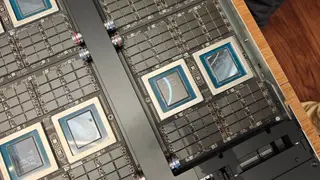
Tom's Hardware conducted a benchmark comparison of Nvidia's Vera data center CPU against Intel's Granite Rapids-AP and AMD's EPYC Turin. The test evaluates Vera's performance in standalone configurations, offering insights into its competitiveness in server environments. Results highlight how Nvidia's entry into CPU design challenges established players in the enterprise computing space.
Nvidia’s Vera data center CPU was recently benchmarked in standalone configurations against Intel’s Granite Rapids-AP and AMD’s EPYC Turin by Tom’s Hardware, marking a pivotal moment in the evolution of custom silicon for enterprise computing. The test focused on performance metrics in server environments, offering an independent evaluation of Vera’s capabilities without integration into Nvidia’s broader GPU-accelerated systems. While specific benchmark scores and performance margins are not detailed in the provided text, the comparison itself signals a strategic shift: Nvidia, long dominant in AI accelerators via its GPUs, is now directly challenging Intel and AMD in the CPU space with a purpose-built data center processor. This move follows earlier industry trends where cloud providers like Microsoft and Meta developed custom chips—such as Microsoft Maia and Meta MTIA—to optimize workloads beyond general-purpose CPUs. The test underscores growing competition in chip design, particularly in high-performance computing and AI-driven data centers.
Nvidia’s entry into CPU design reflects its ambition to control the entire compute stack—from silicon to software—for AI and cloud workloads. Intel and AMD, long entrenched as primary CPU suppliers for servers, now face a new competitor with deep pockets, advanced manufacturing partnerships (like TSMC), and a strong foothold in AI infrastructure. The outcome of these benchmarks may influence enterprise procurement decisions, especially among hyperscalers seeking optimized performance per watt. However, the broader implications remain uncertain: whether Vera can match or exceed its rivals in real-world workloads, how software ecosystems will adapt, and whether Nvidia will prioritize CPU innovation over GPU dominance are still open questions. No information is provided on Vera’s core count, clock speeds, process node, or pricing—key details that would determine market viability.
The benchmarking of Nvidia’s Vera CPU could reshape the server chip landscape by accelerating the trend toward specialized, application-optimized silicon in data centers. Enterprises and cloud providers may increasingly favor custom chips tailored to AI inference, machine learning training, or large-scale data processing, potentially reducing reliance on general-purpose CPUs from Intel and AMD. This shift may benefit companies with significant R&D budgets—like Amazon, Google, and Microsoft—who already invest heavily in bespoke architectures. A comparable precedent is the rise of ARM-based processors in Apple’s Macs and AWS’s Graviton chips, which disrupted traditional x86 dominance in specific segments. If Vera gains traction, it could further fragment the CPU market, increasing complexity for software developers and system integrators. The long-term impact on semiconductor supply chains, manufacturing demand, and innovation incentives remains to be seen. What to watch for next: whether Nvidia will open Vera to third-party OEMs, how quickly software stacks (like Linux distributions and hypervisors) will optimize for it, and whether Intel or AMD respond with faster iterations or new architectural innovations.